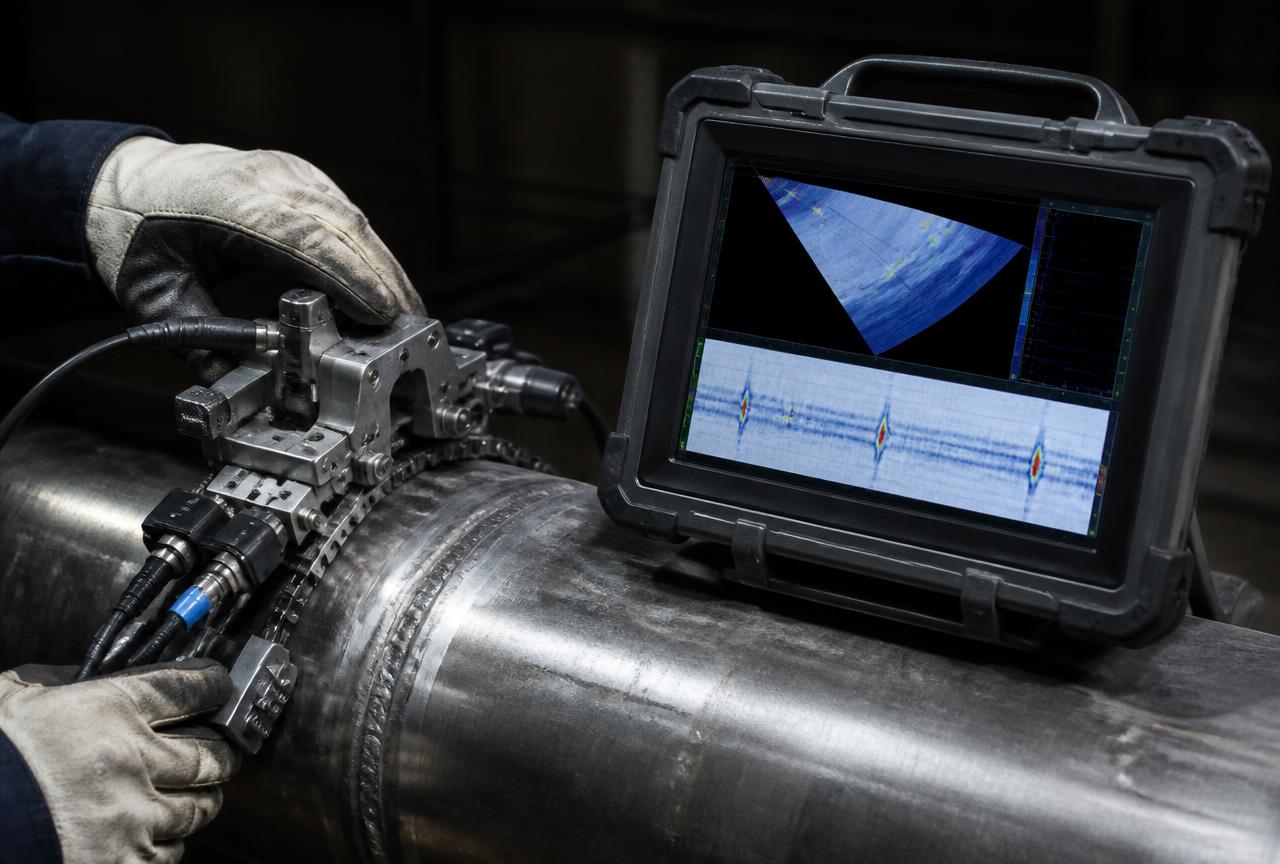
Phased array ultrasonic scanner positioned on a weld with data displayed on the instrument

Services

Advanced NDT — PAUT & TOFD

Encoded, recordable ultrasonic examination for demanding weld inspection scopes, delivered by technicians certified in the applicable technique.

Request a Quote

Advanced Techniques

Recordable Data for Integrity Decisions

Advanced ultrasonic techniques generate encoded data that can be reviewed, archived and compared over time — supporting fitness-for-service and repeat inspection strategies.

PAUT

Phased Array Ultrasonic Testing

Multi-element ultrasonic examination producing sectorial and encoded imaging of the weld volume, with recordable data for review.

Working Principle
An array of elements is pulsed with controlled time delays to steer and focus the beam electronically, allowing a range of angles to be applied from a single probe position.
Typical Indications
  • Lack of fusion
  • Lack of penetration
  • Cracks
  • Slag and porosity
  • Root defects
Applications
  • Pipeline and process piping girth welds
  • Pressure vessel and nozzle welds
  • Structural and heavy-wall welds
  • Corrosion mapping where applicable
Equipment
Portable phased array instruments with encoders, wedges and calibration blocks appropriate to the scope.
Reporting
Encoded data files with sectorial/S-scan and C-scan imaging, indication sizing and evaluation against acceptance criteria.

Application as an alternative to radiography is subject to client approval and the governing code or specification.

Request a Quote
TOFD

Time-of-Flight Diffraction

Ultrasonic technique using diffracted energy from discontinuity tips, providing accurate through-wall height sizing across the weld volume.

Working Principle
A transmitter and receiver pair straddle the weld. Diffracted signals from the extremities of a discontinuity are timed, allowing through-wall position and height to be determined.
Typical Indications
  • Embedded planar flaws
  • Crack height growth
  • Lack of fusion
  • Through-wall sizing of known indications
Applications
  • Heavy-wall vessel and piping welds
  • In-service crack growth monitoring
  • Weld overlay and clad component examination where applicable
Equipment
TOFD-capable instrumentation with encoded scanners and matched probe pairs.
Reporting
Encoded B-scan/D-scan imaging with through-wall sizing and evaluation records.

TOFD is frequently combined with PAUT to compensate for near-surface and lateral wave limitations.

Request a Quote

Technique Comparison

PAUT, TOFD and Radiography

Indicative comparison only. The governing code, client specification and site conditions determine the technique actually applied.

Comparison of PAUT, TOFD and radiographic testing
AspectPAUTTOFDRadiography (RT)
Primary strengthBeam steering and detailed imagingAccurate through-wall sizingPermanent volumetric image
Data recordEncoded, reviewable data filesEncoded, reviewable data filesFilm or digital radiograph
Radiation exposureNoneNoneControlled radiation area required
Site disruptionLow — no exclusion zoneLow — no exclusion zoneHigher — cordoning and timing constraints
Typical limitationSetup and calibration dependentNear-surface dead zoneOrientation-dependent flaw detection

Execution

Advanced NDT Delivery Sequence

  1. 01

    Technique and procedure agreed with client

  2. 02

    Calibration on representative blocks

  3. 03

    Encoded scanning and data acquisition

  4. 04

    Evaluation, reporting and data handover

Planning a PAUT or TOFD Scope?

Share material, thickness, weld configuration and the applicable code — we will propose a suitable technique.