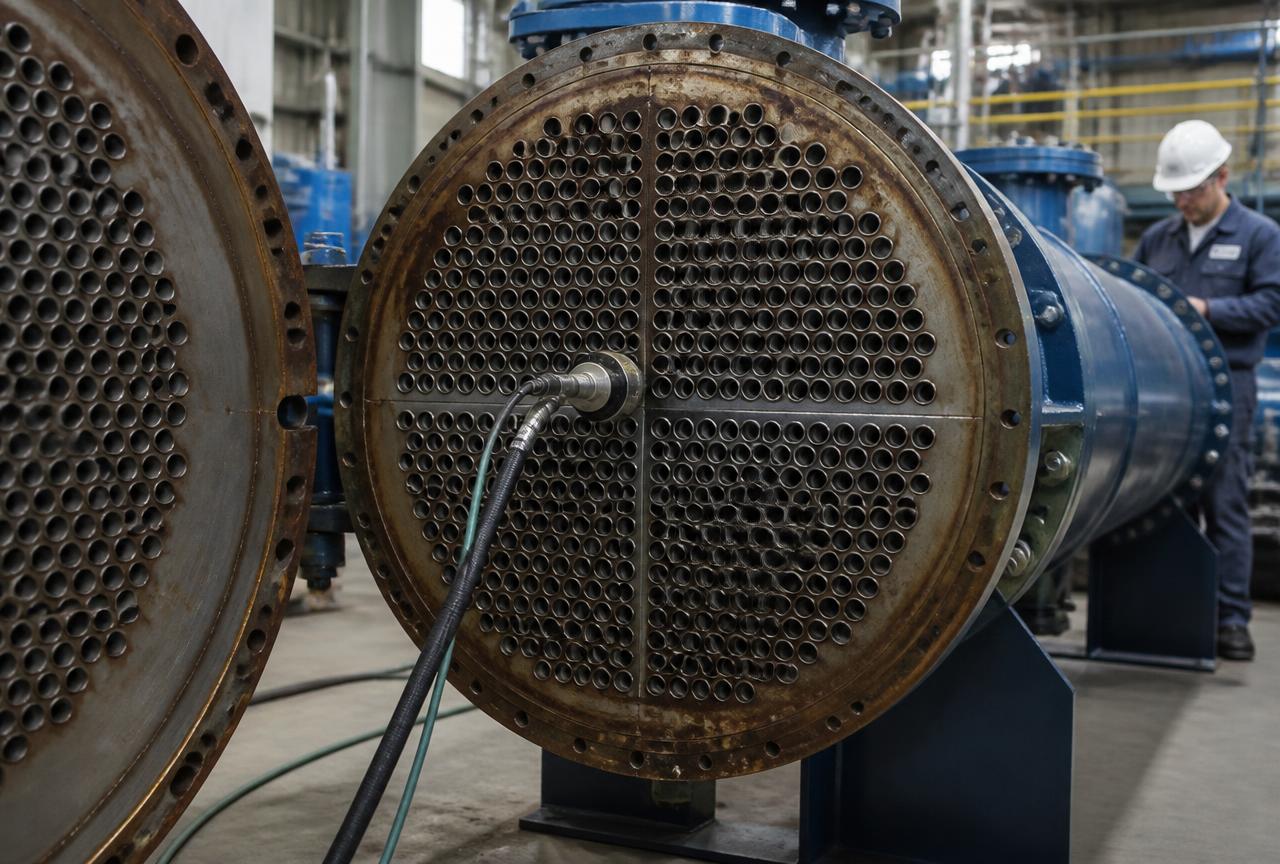
Heat exchanger tube bundle being inspected during a plant shutdown

Services

Tube Inspection

Condition assessment of heat exchanger, condenser, boiler and air cooler tubing using electromagnetic and ultrasonic techniques.

Request a Quote

Techniques

Matching the Technique to the Tube Material

Tube material, wall thickness, fin configuration and the damage mechanism of concern determine which technique is appropriate.

ECT

Eddy Current Testing

High-speed inspection of non-ferromagnetic tubing for wall loss, pitting and cracking.

Working Principle
An excitation coil induces eddy currents in the tube wall. Discontinuities disturb the current flow, producing measurable impedance changes.
Typical Indications
  • Pitting
  • General wall loss
  • Cracking
  • Erosion
  • Baffle-cut wear
Applications
  • Stainless steel and copper alloy exchangers
  • Titanium and brass condenser tubing
  • Air cooler bundles with non-ferrous tubes
Equipment
Multi-frequency eddy current instruments with bobbin probes sized to the tube bore.
Reporting
Tube-by-tube results with percentage wall loss estimation and tube map presentation.
Request a Quote
RFET

Remote Field Eddy Current Testing

Volumetric screening of ferromagnetic tubing where conventional eddy current is not effective.

Working Principle
The remote field zone allows the signal to pass through the tube wall twice, giving comparable sensitivity to internal and external wall loss.
Typical Indications
  • General wall loss
  • External corrosion
  • Erosion
  • Grooving
Applications
  • Carbon steel exchanger and boiler tubes
  • Ferromagnetic air cooler bundles
  • Feedwater heaters
Equipment
Remote field instrumentation with probes matched to tube diameter and wall thickness.
Reporting
Wall loss estimation per tube with indication location along the tube length.
Request a Quote
NFT

Near Field Testing

Focused technique for internal-surface condition assessment of ferromagnetic finned tubing.

Working Principle
A near field probe responds primarily to the tube inner surface, making it well suited to internal corrosion and fouling-related wall loss.
Typical Indications
  • Internal corrosion
  • Internal pitting
  • Inlet-end erosion
Applications
  • Carbon steel air cooler tubes
  • Finned tube bundles
Equipment
Near field probes with instrumentation matched to the tube geometry.
Reporting
Internal wall loss assessment with tube-position mapping.
Request a Quote
IRIS

Internal Rotary Inspection System

Ultrasonic tube inspection providing quantitative wall thickness measurement around the full tube circumference.

Working Principle
A rotating ultrasonic mirror scans the tube wall while the probe is withdrawn, producing a thickness profile along the tube length.
Typical Indications
  • Quantified wall loss
  • Pitting depth
  • Erosion profiles
  • Baffle wear
Applications
  • Verification of ECT/RFET screening results
  • Ferrous and non-ferrous tubing
  • Detailed condition assessment of selected tubes
Equipment
IRIS turbines and probes with water supply, suitable for cleaned tubes.
Reporting
Quantitative thickness data with B-scan and C-scan style presentation where applicable.

IRIS requires clean, water-filled tubes; tube cleaning quality directly affects data reliability.

Request a Quote

Selection Guide

Technique Applicability

Tube inspection technique applicability by material and objective
TechniqueTube materialPrimary objectiveSpeed
ECTNon-ferromagneticScreening for pitting and wall lossHigh
RFETFerromagneticVolumetric wall loss screeningModerate
NFTFerromagnetic finnedInternal surface conditionHigh
IRISFerrous and non-ferrousQuantitative thickness measurementLow — detailed

Execution

Shutdown Tube Inspection Sequence

  1. 01

    Bundle details and history reviewed

  2. 02

    Tube cleaning confirmed by client

  3. 03

    Screening inspection across the bundle

  4. 04

    Verification, tube map and report issue

Planning a Bundle Inspection?

Provide tube material, dimensions, quantity and shutdown window for a technique recommendation.